The Writing Process

Writing advice about the ‘best’ writing process is easy to find.

Some writers enjoy meticulous planning and outlining. They know what’s going to happen from scene-to-scene. Some people like to fly by the seat of their pants and improvise as they go. With one method, you might end up revising more. With the other method, you may revise less but miss some of the thrill of discovery.

Now, if you’re starting out and trying to decide the best way to write – be careful of advice that says you must outline heavily, or that ‘pantsing’ is the only way. Both statements amount to terrible advice.

Instead try both methods. Maybe you find yourself working in both camps. 30% here and 70% there. And that’s ok.

The best advice about writing is to learn how you write.

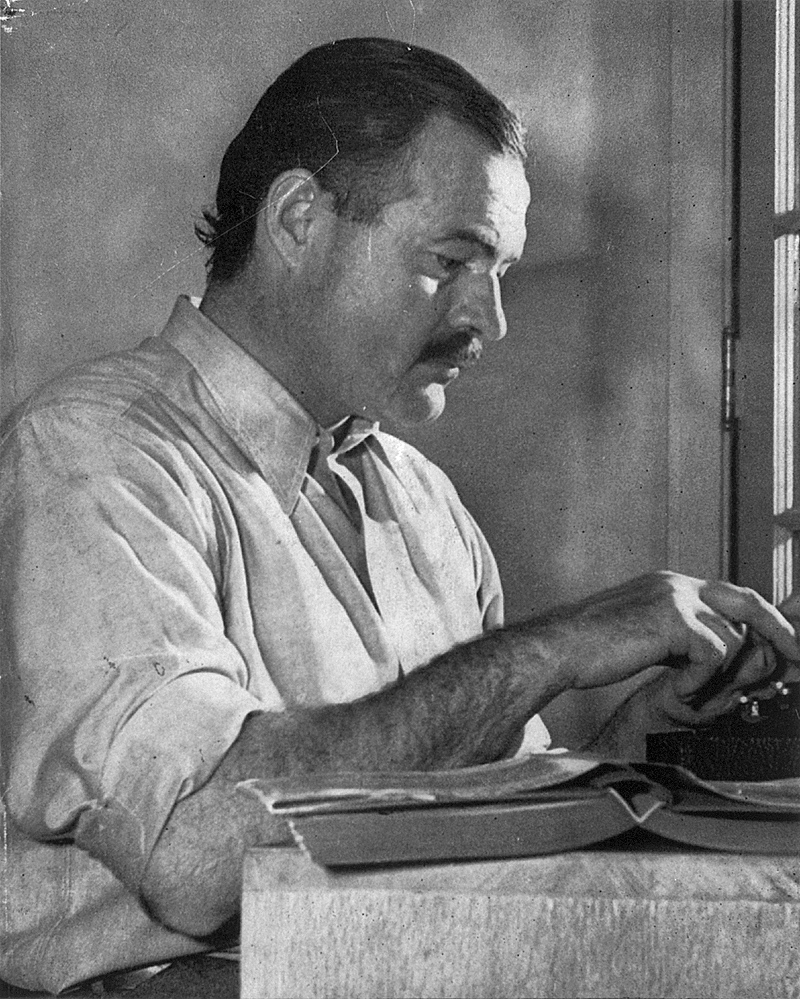
More from Hemingway

hemingway_B

Here’s some more great advice from Hemingway – seven tips for writing fiction, as assembled by Open Culture.

Our favourite from the list is especially useful if you want maintain momentum on a project:

2. Always stop for the day while you still know what will happen next.

This is perfect for long projects. If you know what’s going to happen in the next scene, or the end of your current scene, you’ll return to the story ready to forge ahead.

If the first thing you do when you return to a piece is sit and plan, then you run the risk of a break in forward motion. Your productivity might suffer or even stall – and while there’s a time to think and plan, there’s only one way to finish a project: you have to write!

Foreshadowing

The narrative technique of ‘foreshadowing’ is used to prepare readers with the knowledge they’ll need to best enjoy plot and character developments in the latter parts of a story.

And so the urge for a writer is to give the reader everything they need, so they’re ready. On the other hand, we might want to hold back, keep the reader curious, keep them turning the page. And so which way to go? Foreshadowing can be a fine line between revealing too much too soon or too little too late.

We believe that the stories which handle foreshadowing best are the ones that give the reader enough information up front to build curiosity around questions of how and why as much as and sometimes more than, questions of who, what or whether.

So, for instance, a murder mystery will still work very well if the reader knows who the killer is early on in the story.

What the reader then wants to know most, is how the killer got away with the deed, not whether they will be caught but how they will be caught and why they did it in the first place.

Welcome to 2014 with some Advice from Chuck Palahniuk

Chuck Palahniuk, best known perhaps for Fight Club, has some fantastic advice for writers seeking to ‘show’ more in their fiction.

Have a look right here where he takes aim at eliminating ‘thought’ verbs and provides examples of showing vs telling:

Don’t tell your reader: “Lisa hated Tom.”

Instead, make your case like a lawyer in court, detail by detail. Present each piece of evidence. For example:

“During role call, in the breath after the teacher said Tom’s name, in that moment before he could answer, right then, Lisa would whisper-shout: ‘Butt Wipe,” just as Tom was saying, ‘Here’.”

Magic – it’s got to be more than a deus ex machina in your story

In fantasy fiction, and any fiction that plays with reality, the way a writer uses magic is vital. It can both create a sense of wonder and the necessary suspension of disbelief. For those of you creating your own worlds, the way you employ magic as a story element has to feel reasoned. As if you as the author have considered the impact of magic on your world, not just the plot.

Over the years, best-selling fantasy author Brandon Sanderson has written a few essays on aspects that he feels constitutes a great magic system. They’re incredibly useful posts and we wanted to draw your attention to them.

Below is a quote from the ‘laws’, but it’s worth reading the whole of each essay.

The First Law

An author’s ability to solve conflict with magic is DIRECTLY PROPORTIONAL to how well the reader understands said magic.

The Second Law

Limitations > Powers

Or

Superman is not his powers. Superman is his weaknesses.

The Third Law

Expand what you already have before you add something new.

Hemingway & Short Sentences

Today, a short post on Hemingway’s four writing rules. His sparse, direct style is much-emulated and will no doubt remain so for a long time.

There are some interesting claims, especially the idea of being ‘positive’ instead of ‘negative,’ but perhaps the simplest ‘rule’ to embrace when working toward a minimalistic style is Hemingway’s first:

1. Use short sentences.

Long sentences have their place in writing. Complex ideas require complex construction, but remember, the more sub-clauses used, the more information you force your reader to store within their temporary or ‘working’ memory. Overload that memory and the reader has to re-read a sentence, and in fiction particularly, this can risk breaking ‘suspension of disbelief’ or pulling the reader out of the story.

So wherever possible, keep ‘em short.

Write What you Know – Tiny Masters

Over at Creative Nonfiction there’s a great post explaining Susan Orlean’s notion of Tiny Masters.

It’s a brilliant idea and the perfect answer for writers who feel, each time they see the advice write what you know, that they don’t know ‘anything.’ In short, you probably do, you just haven’t realised it yet.

Here’s an example of how it works, taken from the Creative Nonfiction link above:

Make a list of 10 things of which you’re a master. Include talents, skills, hobbies, qualities of character. I’ve created many lists over the years, and they surprise me every time: Making enchilada sauce. Building fires. Finding beach glass. Crossing rivers. Writing thank you notes. Collecting maps. Procrastinating. Teaching tricks to my dog.

Next, you incorporate a mastery into a story or character.  It’s pretty much that easy!

Tiny Masters is useful because the kind of ‘smaller’ detail you’re using will add depth to your work, and because you the writer are confident in that mastery, your writing will naturally have an assured tone or ring of truth to it.

Now, to answer those of you thinking, ‘wait a minute, I’m writing in a speculative fiction genre and I don’t personally know anything about so and so’ (maybe it’s ‘space’) then not to worry.

One answer might be that while you don’t know a tonne about space, you do know about cooking. And so in your story, your character is a cook. Your knowledge of cooking becomes part of the authenticity, and what you choose to do with space, remains the speculative aspect.

Try it out!

 

When is your manuscript ready? (Part 2)

Following up from a previous post, we thought it would be useful to share some advice from literary agent Carole Blake.

It’s about that next step, about when you have your manuscript ready to query. You may wish to submit a proposal to a literary agent. If so, Carole Blake has some cracking advice on what NOT to do.

Take heed! 

How much can your verbs bench press?

You’ve heard the advice – make your verbs stronger.

Well, it is good advice. Unless you’re purposefully trying to make a character seem passive or downtrodden perhaps, you should aim for strong verbs, or certainly for variety in your verbs. Sometimes the simpler word will do – but not always.

Therese Stenzel has a useful list here. For example, take ‘sat.’ Sat could be switched for some of the words below, depending on the context. What kind of character is sitting? Where are they sitting?

Sat: eased into, settled, took, perch, plop down, relaxed into

For instance, an injured or elderly character might ‘ease into’ an armchair. By using ‘ease’ instead of sat, you’ve shown the reader something about that character. Your verb is working harder for you, its pulling its weight.

Now, some of the words on the list we’ve linked to might not always need changing. Further to this, ‘looked’ is an interesting one. Looked can impact on point of view, and act as a ‘filtering’ word. A  filtering word is something which may distance the reader from your character or action, which is not desirable.

But more on that topic next time!