
Jake Kerr on ‘The Art of Revision’

Very simply, this is one of the best articles we’ve seen on revision.

Jake Kerr on Revision:

Revision requires you to recognize a gap between what you intended and what you achieved. Closing that gap is pretty much the definition of revision. But if you recognized that gap initially, you wouldn’t have made the mistake, so I call these gaps “blind spots.” Blind spots are different than grammatical ignorance or oversight (such as using a colon wrong). Blind spots are things like weaving in a sub-plot that powers an entire character arc but that actually doesn’t exist on the page–only in your head.

My biggest personal blind spot is not being clear enough in outlining character motivation. Critique partners will often say, “I don’t understand why that happened” or “I don’t know why she did that.” Thus one of the first things I do in revision is go through and make sure all the pieces of the narrative are clearly communicated. It’s so basic, but it is something I miss all the time.
The Writing Process

Writing advice about the ‘best’ writing process is easy to find.

Some writers enjoy meticulous planning and outlining. They know what’s going to happen from scene-to-scene. Some people like to fly by the seat of their pants and improvise as they go. With one method, you might end up revising more. With the other method, you may revise less but miss some of the thrill of discovery.

Now, if you’re starting out and trying to decide the best way to write – be careful of advice that says you must outline heavily, or that ‘pantsing’ is the only way. Both statements amount to terrible advice.

Instead try both methods. Maybe you find yourself working in both camps. 30% here and 70% there. And that’s ok.

The best advice about writing is to learn how you write.

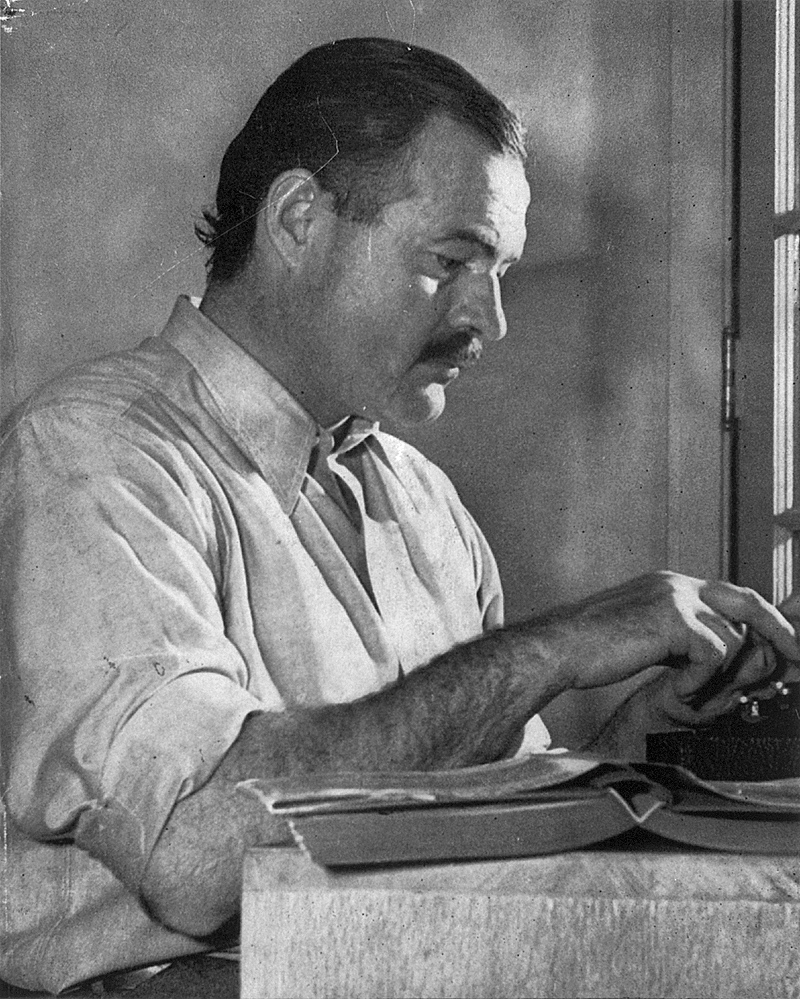
More from Hemingway

hemingway_B

Here’s some more great advice from Hemingway – seven tips for writing fiction, as assembled by Open Culture.

Our favourite from the list is especially useful if you want maintain momentum on a project:

2. Always stop for the day while you still know what will happen next.

This is perfect for long projects. If you know what’s going to happen in the next scene, or the end of your current scene, you’ll return to the story ready to forge ahead.

If the first thing you do when you return to a piece is sit and plan, then you run the risk of a break in forward motion. Your productivity might suffer or even stall – and while there’s a time to think and plan, there’s only one way to finish a project: you have to write!

Foreshadowing

The narrative technique of ‘foreshadowing’ is used to prepare readers with the knowledge they’ll need to best enjoy plot and character developments in the latter parts of a story.

And so the urge for a writer is to give the reader everything they need, so they’re ready. On the other hand, we might want to hold back, keep the reader curious, keep them turning the page. And so which way to go? Foreshadowing can be a fine line between revealing too much too soon or too little too late.

We believe that the stories which handle foreshadowing best are the ones that give the reader enough information up front to build curiosity around questions of how and why as much as and sometimes more than, questions of who, what or whether.

So, for instance, a murder mystery will still work very well if the reader knows who the killer is early on in the story.

What the reader then wants to know most, is how the killer got away with the deed, not whether they will be caught but how they will be caught and why they did it in the first place.

Hemingway & Short Sentences

Today, a short post on Hemingway’s four writing rules. His sparse, direct style is much-emulated and will no doubt remain so for a long time.

There are some interesting claims, especially the idea of being ‘positive’ instead of ‘negative,’ but perhaps the simplest ‘rule’ to embrace when working toward a minimalistic style is Hemingway’s first:

1. Use short sentences.

Long sentences have their place in writing. Complex ideas require complex construction, but remember, the more sub-clauses used, the more information you force your reader to store within their temporary or ‘working’ memory. Overload that memory and the reader has to re-read a sentence, and in fiction particularly, this can risk breaking ‘suspension of disbelief’ or pulling the reader out of the story.

So wherever possible, keep ‘em short.